
The short answer
Restaurant SEO is how you make sure the right people find your restaurant when they search for somewhere to eat, on Google Search, Google Maps and increasingly on AI assistants like ChatGPT. Google ranks local results on three signals: relevance, distance and prominence. You can’t move your restaurant, but you can control the other two.
It matters because almost every guest checks before they choose. 97% of consumers read reviews for local businesses, and 45% now use ChatGPT or other AI tools for local recommendations (BrightLocal Local Consumer Review Survey, 2026). If your information is thin, out of date or inconsistent, the search moves on to the restaurant down the road.
1. Google Business Profile: your real front door
For “near me” searches, your Google Business Profile does more work than your website. Google says customers are 70% more likely to visit a business with a complete profile (via BrightLocal).
Get these right first:
- Primary category. Be specific: “Italian restaurant” beats “Restaurant”. Add secondary categories for what you genuinely offer (takeaway, brunch, private dining).
- Hours, including special hours. Wrong hours over a bank holiday cost bookings and earn angry reviews.
- Booking and ordering links. Point “Reserve a table” and “Order online” at your own booking and ordering pages, not a marketplace that charges you commission.
- Menu. Add it as text or a link to your website’s menu page, not a photo of a printed menu.
- Photos every month. Exterior, room, team and three or four signature dishes. Recent photos tell Google, and guests, that you’re open and active.
- Description and attributes. Say plainly what you serve and who you’re for, and tick every attribute that applies (outdoor seating, vegan options, step-free access).
Our Google Maps guide has a one-week checklist for this.
2. Your website: the source Google and AI assistants check
Your website is where search engines and AI assistants confirm what your profile says. A few fixes make a large difference:
- Put the menu on the page as text, with prices. A PDF or image menu is hard for search engines to read and slow on a phone.
- Make the name, address and phone number match your Google profile exactly, on every page footer.
- One clear page per thing guests search for: menu, private dining, catering, gift vouchers, each location. “Private dining in Leith” can’t rank if there’s no page about it.
- Load fast on a phone. Most restaurant searches happen on mobile, often on the move.
- Add structured data. Restaurant schema (cuisine, price range, opening hours, menu URL, booking URL) tells search engines exactly what you are.
- Write a plain opening line on the homepage: what you are, where, and what you serve. AI assistants lean heavily on the first lines of a page when they summarise it.
Restaurant website design covers what a high-converting restaurant site needs.
3. Reviews: prominence you can earn every night
Reviews are the clearest prominence signal you control. They influence where you rank and whether people click.
- Ask at the right moment. The best time is just after a great visit: a message after the bill is paid, or a QR code on the receipt. Never offer incentives for positive reviews; that breaks Google’s policies.
- Reply to every review, good and bad, within two days. A calm, specific reply to criticism reassures the next reader more than another five-star review.
- Keep them coming. A steady flow of recent reviews beats a burst of old ones. AI assistants also favour well-rated businesses. The local businesses ChatGPT recommends average 4.3 stars (SOCi Local Visibility Index, 2026).
See how to get more Google reviews for scripts and timing.
4. Listings and mentions: be consistent everywhere
Search engines and AI assistants cross-check you across the web. Make your name, address, phone number, hours and website identical on:
- Google, Apple Maps and Bing Places
- TripAdvisor, Yelp and OpenTable or your booking listings
- Delivery apps, if you use them
- Local guides, tourism boards and your suppliers’ “where to find us” pages
Then earn mentions from local sites: a write-up in the local paper, a food blogger’s review, an event listing, a charity you sponsor, your town’s business association. Each one is a vote that you’re a real, well-known place. That is prominence in Google’s terms.
5. AI search: how to get recommended by ChatGPT and Google’s AI answers
AI assistants don’t rank ten blue links. They pick a few places and explain why. Independent research found that 85.6% of venues were never recommended by any of four AI systems tested (arXiv, 2026). The ones that are tend to have the same things in common:
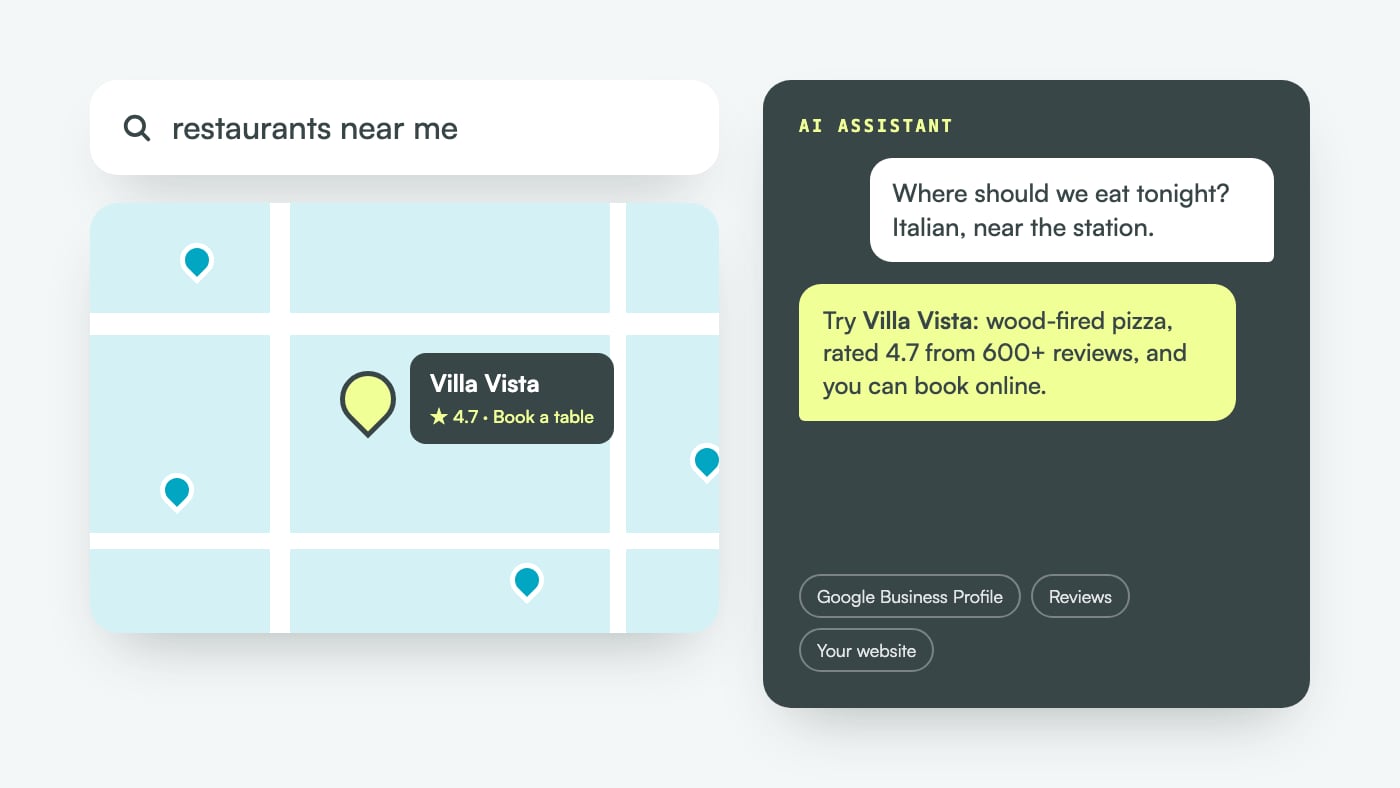
- Consistent facts across many sources. If your profile, website, TripAdvisor and a local article all agree on what you serve, AI assistants are more confident recommending you.
- Specific, quotable details. “Wood-fired Neapolitan pizza, open until 11pm, private room for 24” is easier to recommend than “great food and atmosphere”.
- Recent, positive reviews that mention the dishes and occasions people search for (“great for birthdays”, “best Sunday roast”).
- A text menu and FAQ on your website that answer the questions guests ask: dietary options, parking, children, dogs, group bookings.
We cover how discovery is shifting in how customers find restaurants in 2026.
Your restaurant SEO checklist
| Area | Task | Time | Impact |
|---|---|---|---|
| Google profile | Complete category, hours, links, menu and photos | 1–2 hours | High |
| Google profile | Point booking and order links to your own pages | 15 minutes | High |
| Website | Text menu with prices | 1 hour | High |
| Reviews | Ask after every visit and reply to every review | 10 minutes a day | High |
| Listings | Match name, address, phone and hours everywhere | 1–2 hours | Medium |
| Website | One page per occasion and location | Half a day | Medium |
| Website | Restaurant structured data | 1 hour | Medium |
| Google profile | Fresh photos | 20 minutes a month | Medium |
| Press | One local story or partnership each quarter | A few hours | Medium, compounding |
How to measure it
- Google Business Profile Performance: searches, views, calls, direction requests, and booking and order clicks.
- Google Search Console: which searches show your website, and where it ranks.
- Your own bookings and orders: ask “how did you find us?” in the booking form, and track how many come direct versus through marketplaces.
- AI assistants: once a month, ask ChatGPT and Google “best [cuisine] restaurant in [your area]” and note whether you appear.
How Growtality helps
Growtality gives your restaurant the pieces search rewards and guests use: a fast, mobile-first restaurant website with a text menu, booking and ordering links you can put straight on your Google profile, and review requests sent at the right moment after every visit. Every guest who finds you lands in your own guest list, not a marketplace’s.
Plans start at £29 a month with a 14-day free trial.
Questions owners ask
What is restaurant SEO?
Restaurant SEO is the work of making a restaurant easy to find when people search for somewhere to eat on Google Search, Google Maps and AI assistants like ChatGPT. It covers the Google Business Profile, the restaurant's own website, reviews, consistent listings across the web and mentions from other sites.
How long does restaurant SEO take to work?
Google Business Profile fixes (categories, hours, photos, booking and order links) can change Maps visibility within weeks. Website and review improvements usually take two to three months to show in rankings. Links and press mentions build over six months or more, and they compound.
Can ChatGPT do SEO for my restaurant?
AI tools can draft menu descriptions, review replies and page copy, but they can't claim your Google Business Profile, earn reviews or get local press to mention you. Those are the signals Google and AI assistants rely on most. Use AI to save writing time, and check every fact it produces.
How much does restaurant SEO cost?
The basics cost time rather than money: an owner can complete the Google Business Profile, fix the website and set up a review routine in a few hours, then spend an hour a week keeping it current. Agencies charge monthly retainers that vary widely, so ask exactly what work is included before signing.
Do restaurants need a website if they have a Google Business Profile?
Yes. The profile gets you onto the map, but Google and AI assistants also read your website to confirm what you serve, your prices and your opening hours. A fast website with a text menu and direct booking and ordering links also turns that search into a booking you own.