

The short answer
A typical UK full-service restaurant keeps 3–6p of profit from every £1 of sales. Quick-service restaurants keep a little more, at 6–9%, and delivery-led kitchens can reach 10–30% because they carry no dining room (Tenzo, 2026).
At the top of the market, margins are even thinner. The UK’s 100 largest restaurant groups made a combined profit of £204m on £13.3bn of sales, about 1.5%, after profits fell 44% in a year as employment and food costs rose (UHY Hacker Young via The Caterer, 2026).
So when a restaurant feels busy but the bank balance doesn’t move, the menu is rarely the only problem. Costs are, and so is the sales channel each order comes through.
Gross margin vs net margin
The two numbers answer different questions, and mixing them up is the most common margin mistake.
Gross profit margin shows how much each sale leaves after food and drink costs:
Gross margin = (sales − cost of food and drink) ÷ sales × 100
A UK full-service restaurant should aim for 65–75%. Below 60% usually means portions, waste or supplier prices need attention.
Net profit margin is what’s left after everything: labour, rent, utilities, marketing, card fees, commissions and tax:
Net margin = net profit ÷ sales × 100
This is the number that pays back loans and funds the next refit. For most full-service restaurants it sits at 3–6%.
2026 UK benchmarks by restaurant type
| Restaurant type | Typical gross margin | Typical net margin |
|---|---|---|
| Full-service / casual dining | 60–70% | 3–6% |
| Fine dining | Under 70% | 3–6% |
| Quick-service / fast casual | 70%+ | 6–9% |
| Delivery-led / ghost kitchen | 60–65% | 10–30% |
Source: Tenzo, What is a good profit margin for a restaurant in 2026?
Two cost lines decide where you land in that range:
- Prime cost (food plus labour) should sit at 55–65% of sales for a full-service restaurant. Above 70% is a warning sign (Tenzo).
- Labour keeps climbing. The National Living Wage rose to £12.71 an hour in April 2026, so every rota decision now carries more weight.
Where £100 of sales actually goes
Here’s an illustrative split for a full-service restaurant that sits in the middle of the benchmarks:
| Cost | Of every £100 |
|---|---|
| Food and drink | £30 |
| Labour | £30 |
| Rent, rates and utilities | £15 |
| Marketing, software, card fees, repairs and other overheads | £21 |
| Net profit | £4 |
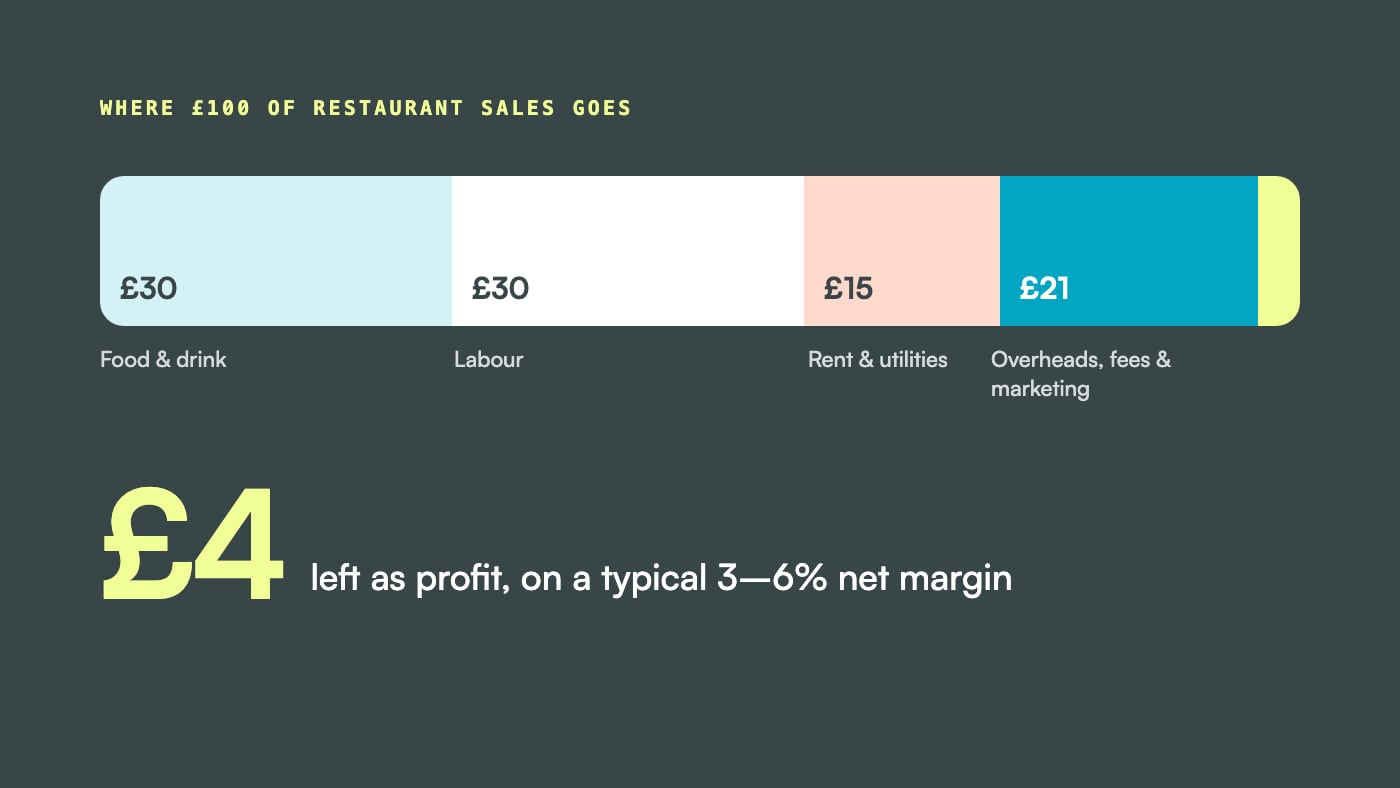
Every pound you take out of costs goes straight to that last line. At a 4% margin, saving £1 does as much for profit as roughly £25 of extra sales.
The margin nobody puts on the P&L: sales channel
Most margin guides stop at food cost and labour. But the same dish earns very different amounts depending on how the guest ordered it.
Take a £40 order with £12 of food cost (£13 once delivery packaging is added). Before labour and overheads, here’s what each channel leaves:
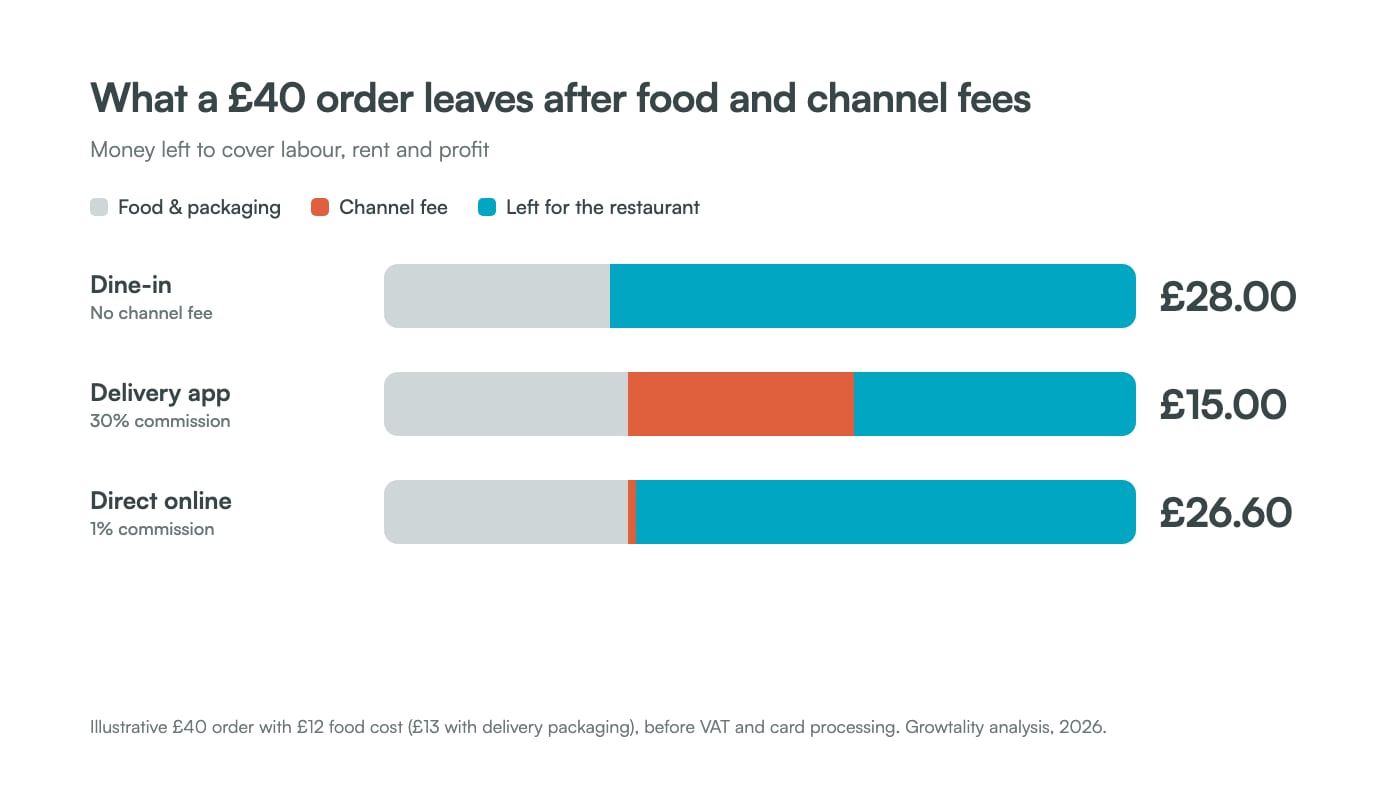
| Channel | Food & packaging | Channel fee | Left to cover labour, rent and profit |
|---|---|---|---|
| Dine-in | £12.00 | £0 | £28.00 |
| Delivery app at 30% commission | £13.00 | £12.00 | £15.00 |
| Direct online order at 1% | £13.00 | £0.40 | £26.60 |
Illustrative figures before VAT and card processing, which apply on every channel. Delivery apps typically charge 20–30% commission.
The delivery-app order leaves almost half as much as the same order taken direct. For a restaurant running at a 4% net margin, that £12 commission is three times the profit on the whole order. Delivery apps are useful for reaching new guests. But every repeat order that stays on the app quietly pays someone else’s margin instead of yours.
To see this for your own numbers, the commission savings calculator works it out from your monthly order volume, average order value and commission rate.
How to calculate your own margin in 10 minutes
- Pick a full month and pull total sales (net of VAT) from your till or accounts.
- Add up cost of goods: food and drink purchases, adjusted for stock at the start and end of the month.
- Work out gross margin: (sales − cost of goods) ÷ sales × 100.
- Add every other cost for the same month: wages including employer NI and pension, rent, rates, energy, card fees, delivery commissions, software, marketing and repairs.
- Work out net margin: (sales − all costs) ÷ sales × 100.
- Split sales by channel (dine-in, delivery app, direct online, events) and repeat steps 3–5 for each. This is the step most restaurants skip, and where the biggest surprises usually are.
Seven ways to raise your margin without raising every price
1. Move regulars off the apps. Your loyal guests already know your name. Give them a direct ordering link, a reason to use it (a loyalty stamp, a free side on the first direct order) and remind them by email or SMS. For a busy takeaway, moving even a third of repeat orders can be worth thousands a year.
2. Engineer the menu, not just the prices. Your best seller can be your least profitable dish. Price each dish on its contribution, not its food-cost percentage alone. See menu engineering in 2026.
3. Cut no-shows. An empty table on a fully booked night costs the whole margin of that cover. Deposits and automatic reminders recover most of it. Here’s how to stop no-shows.
4. Fill the quiet days. Rent and core staff cost the same on Tuesday as on Saturday. A midweek offer for lapsed guests, or corporate catering, turns fixed cost into margin. Read why empty Tuesdays cost more than busy Saturdays.
5. Sell the high-margin occasions. Private dining, events and catering are pre-booked and pre-paid, so they waste less and run at much higher margins. See private dining and events.
6. Bring guests back more often. A guest who returns once more a year costs nothing to acquire. A simple loyalty programme and a guest CRM that remembers preferences do this without discounting every visit.
7. Consolidate your software. Separate booking, ordering, CRM, website and marketing tools often cost several hundred pounds a month between them, and the data doesn’t connect. One platform removes the overlap.
How Growtality helps
Growtality is built around one idea: restaurants should keep more of what they earn. Direct online ordering costs 1% per order instead of 20–30%. Bookings with deposits and reminders, a guest CRM, loyalty and marketing sit in the same platform, so your regulars order and book direct, and every visit builds a guest list you own.
Plans start at £29 a month with a 14-day free trial. Run your own numbers first.
Questions owners ask
What is a good profit margin for a restaurant?
For a UK full-service restaurant, a net profit margin of 3–6% is typical and anything above 6% is strong. Quick-service sites usually run 6–9%, and delivery-led kitchens can reach 10% or more. Judge gross margin separately: 65–75% after food and drink costs is a healthy target.
Is a 30% profit margin good for a restaurant?
A 30% net margin is far above normal for a restaurant, where 3–9% is typical. A 30% figure usually describes something else: a contribution margin before labour and rent, or the margin on a single high-margin line such as drinks, corporate catering or private events.
Why are restaurant profit margins so low?
Food and labour together (prime cost) usually take 55–65% of sales, rent and overheads take another 20–30%, and both are rising. On top of that, delivery apps charge around 30% commission on every order they bring, which can wipe out the profit on that order entirely.
How do you calculate a restaurant's profit margin?
Net profit margin = net profit ÷ total sales × 100. Take total sales for the period, subtract every cost (food, drink, labour, rent, utilities, marketing, commissions and fees), divide what's left by sales and multiply by 100. Gross margin uses only food and drink costs: (sales − cost of goods) ÷ sales × 100.
How much profit does a restaurant make per month in the UK?
Multiply monthly sales by your net margin. A restaurant taking £40,000 a month at a 4% net margin keeps about £1,600; at 6% it keeps £2,400. That's why small cost changes, such as moving regular orders off delivery apps, have an outsized effect on take-home profit.